Bridget A. Thomas
Every day is a gift!
Psalm 23 – Verse 6

Surely goodness and mercy shall follow me all the days of my life; And I will dwell in the house of the Lord Forever. – Psalm 23:6 NKJV
Over the last several weeks we have gained incredible insight on how deeply our Good Shepherd cares for us. He is always watching out for us, protecting us, guiding us, and making sure our needs are met. This has helped us come to an understanding of how His goodness and mercy have always been, and will always be, poured out in our lives.
W. Phillip Keller puts it this way, “Throughout the study of this psalm, continuous emphasis has been put upon the care exercised by the attentive sheepman. It has been stressed how essential to the welfare of the sheep is the rancher’s diligent effort and labor. All the benefits enjoyed by a flock under skilled and loving management have been drawn in bold lines. Now all of this is summed up here by the psalmist in one brave but simple statement: ‘Surely goodness and love will follow me all the days of my life!’” [1]
Surely goodness and mercy shall follow me all the days of my life
Let’s take a closer look at the pieces of this declaration.
Surely – I appreciate that this verse starts with the word “surely.” This tells us that there is no doubt. This is a deep assurance that God’s love and mercy will follow us. The original Hebrew word here could also be interpreted as “only.” And some Bible translations begin with that word, rather than “surely.” Ponder that for a moment: “Only goodness and mercy follow me all the days of my life.”
This doesn’t mean that David was naive about reality and life. Recall that scholars believe the twenty-third Psalm was written later in David’s life, after he faced many challenges. So what this means is that David can look back at his trials and his mistakes, and he can see how through it all God’s goodness and mercy were there. Life’s difficulties might be great, but God’s goodness and mercy are greater.
Goodness and mercy – These two words are who God is. He can never be anything contrary to who He is because He never changes. This gives us another assurance that we will always have His goodness and mercy.
“Our moods may shift, but God doesn’t. Our minds may change, but God doesn’t. Our devotion may falter, but God’s never does. Even if we are faithless, he is faithful, for he cannot betray himself (2 Timothy 2:13). He is a sure God.” [2]
Goodness – In our English translations this word doesn’t have as much of an impact as the Hebrew word.
“Goodness is almost too big a biblical term to describe. The Hebrew word David used refers to goodness in its broadest sense, covering physical, moral, practical, economic, spiritual, emotional, and eternal grace toward us in all its dimensions.” [3]
We often say, “God is good.” And that’s try. However, that statement sounds weak in comparison to how vast God’s goodness is. And because we are His beloved children, His unlimited goodness follows us all of our days.
Mercy – Different Bible translations express this word as love, unfailing love, faithfulness, lovingkindness, or faithful love. When we add those words in, it broadens our perspective. “Surely goodness, mercy, unfailingly love, and faithfulness will follow me all the days of my life.”
There are numerous authors who portray goodness and mercy as two sheepdogs in the herd. Sheepdogs are loyal and energetic. So I picture them being relentless when it comes to their duties. And similarly God is relentless in His goodness and mercy.
Follow – Many scholars agree that this was a weak translation and would be better portrayed as “pursue.” Let’s think about that for a moment – “Surely goodness and mercy shall pursue me all the days of my life.” That gives us a whole new outlook. Being followed could be seen as trailing behind. The word “pursue” on the other hand has more of an impact. It leaves an impression of diligence. We might picture more of a chase. And now we can see why some authors use the analogy of two sheepdogs.
All the days of my life – There was a time in my life when I was far from God. Perhaps many of us can say the same. Yet, even when we were far away, God’s love pursued us. He left the ninety-nine to come after us and bring us back to the flock. (See Luke 15 and Matthew 18:12-14.)
Looking at the past and the ways God has been there for us before, and thus realizing how God is faithful and will be there for us in each day ahead, this helps us to declare – “Surely Goodness and mercy shall follow me all the days of my life.” May we praise God and express our gratitude for His unfailing love – all the days of our lives.
And I will dwell in the house of the Lord forever
These words have a twofold impact for us as Christians. First, while we are here on earth, we will always have the Lord’s presence with us.
In John 14:16-17 (NKJV), Jesus assures us that the Holy Spirit will always be with us. “And I will pray the Father, and He will give you another Helper, that He may abide with you forever— the Spirit of truth, whom the world cannot receive, because it neither sees Him nor knows Him; but you know Him, for He dwells with you and will be in you.”
The original disciples needed to wait for the Holy Spirit to be sent. However, for us, we have the Holy Spirit as soon as we give our lives to Jesus.
There is a particular Greek word used in the verses above that I want to point out. It occurs twice as the words abide and dwell, which are both the same original word with a meaning of: “To stay (in a given place, state, relation or expectancy):—abide, continue, dwell, endure, be present, remain, stand, tarry.” [4]
When we became Christians, the Holy Spirit came to live inside us. And considering the meaning of the original words spoken by Jesus, He is saying that the Holy Spirit will continually dwell in us.
Dr. Charles Stanley wrote, “I often hear Christians pray to invite God’s Spirit to join them. The truth is, we don’t need to invite the Lord to come into our presence. We are always in His presence! We are never apart from Him.” [5]
What a gift it is to know that the Lord’s presence is always with us. We can dwell with Him all of our days. We can call on Him day and night. Anytime we need His help, He is already there to help us, guide us, and bring us comfort.
And when we depart from this earth, we will be with the Lord for all eternity. Jesus said in John 14:2-3 (NKJV), “In My Father’s house are many mansions; if it were not so, I would have told you. I go to prepare a place for you. And if I go and prepare a place for you, I will come again and receive you to Myself; that where I am, there you may be also.”
For all eternity we will be with Jesus in heaven. The most famous verse in the Bible, John 3:16 (NIV) says, “For God so loved the world, that he gave his only Son, that whoever believes in him should not perish but have eternal life” (emphasis added). These words were spoken by Jesus Himself. And He promised us eternal life when we believe in Him.
I admit I have a difficult time wrapping my head around the thought of “forever.” It’s hard to fathom something that has no end. Yet heaven is our eternal home.
Philippians 3:20 says that our citizenship is in heaven. Our time on this earth is temporary. And when we compare it to our time in heaven, our time on this earth is only a blink. This reminds me of the importance of being present here and now. Each moment is a gift from God. Every day we have the opportunity to make the most of our time, enjoy our lives, and work for the Kingdom of God.
“He is leading us home, yes, but the way to his house is a scenic route we need to savor.” [6]
This is the final verse in Psalm 23 and therefore concludes this series. I hope you have enjoyed this study as much as I have. Thank you for joining me on this journey!
© 2018-2025 Bridget A. Thomas. All rights reserved.
[1] A Shepherd Looks at Psalm 23 by W. Phillip Keller. Copyright © 1970, 2007, 2015 by Phillip Keller. Published in Grand Rapids, Michigan, by Zondervan.
[2] Safe in the Shepherd’s Arms: Hope and Encouragement from Psalm 23 by Max Lucado. Copyright © 2002, 2009 by Max Lucado. Published by Thomas Nelson.
[3] The Lord is My Shepherd by Robert J. Morgan. Copyright © 2013 by Rob Morgan. Published by Howard Books.
[4] https://www.blueletterbible.org/lexicon/g3306/kjv/tr/0-1/
[5] When the Enemy Strikes © 2004 by Charles F. Stanley. Published by Thomas Nelson.
[6] The Lord of Psalm 23: Jesus Our Shepherd, Companion, and Host © 2023 by David Gibson. Published by Crossway.
Advent 2025
There is something special about this time of year, as the world around us anticipates the approach of Christmas Day. Many say the Christmas season begins the day after Thanksgiving. In the Christian church, this season is better known as Advent, which officially begins each year on the fourth Sunday prior to Christmas. And with today being that fourth Sunday, today is the first day of Advent. The word “Advent” is Latin and it means “coming.” Many churches observe Advent and Christ’s coming by lighting a candle on the four Sundays before Christmas. The four candles represent Hope, Peace, Joy, and Love.
Advent has an additional meaning for Christians, because we are waiting for Jesus’ second arrival. Luke 21:27 (NKJV) reminds us, “Then they will see the Son of Man coming in a cloud with power and great glory.” What a glorious day that will be!
Unfortunately, the Advent season can feel hectic to many of us, with additional shopping, cooking, planning, decorating, and more. And with the busyness and distractions this season brings, it seems to zip by so fast.
That’s why it’s important for us to be intentional about celebrating Advent. We have to make the choice to slow down and focus on the reason for the season – Jesus.
If you are looking for meaningful devotions this December to help you savor our Savior, I invite you to check out the blogs listed below. One of my blogging friends had an idea to spread the love of Jesus this Advent season; and several other bloggers joined in.
Loring Schultz – Word For The Soul
Alan Kearns – Devotional Treasure
Nathan R Dooley – Time For Providence
David Duncan – David’s Daily Dose
Rainer Bantau – The Devotional Guy
Cindi West – God Still Speaks
Barb Hegreberg – My Life in our Father’s World
I hope you find some inspiration and encouragement through these links. Since I am still working on the series from Psalm 23, my friend, Rainer over at The Devotional Guy™, will be graciously sharing some guest posts I’ve written for Advent.
(And a quick note that I won’t be posting this Tuesday. I will be back on December 9 to continue the Psalm 23 series.)
Thank you for stopping by. I pray that in the weeks ahead, in the midst of the hustle and bustle, you are able to take some time to slow down and focus on Jesus. Remember how much His birth, life, death, and resurrection mean to us.
#ADVENT2025

© 2018-2025 Bridget A. Thomas. All rights reserved.
Happy Thanksgiving
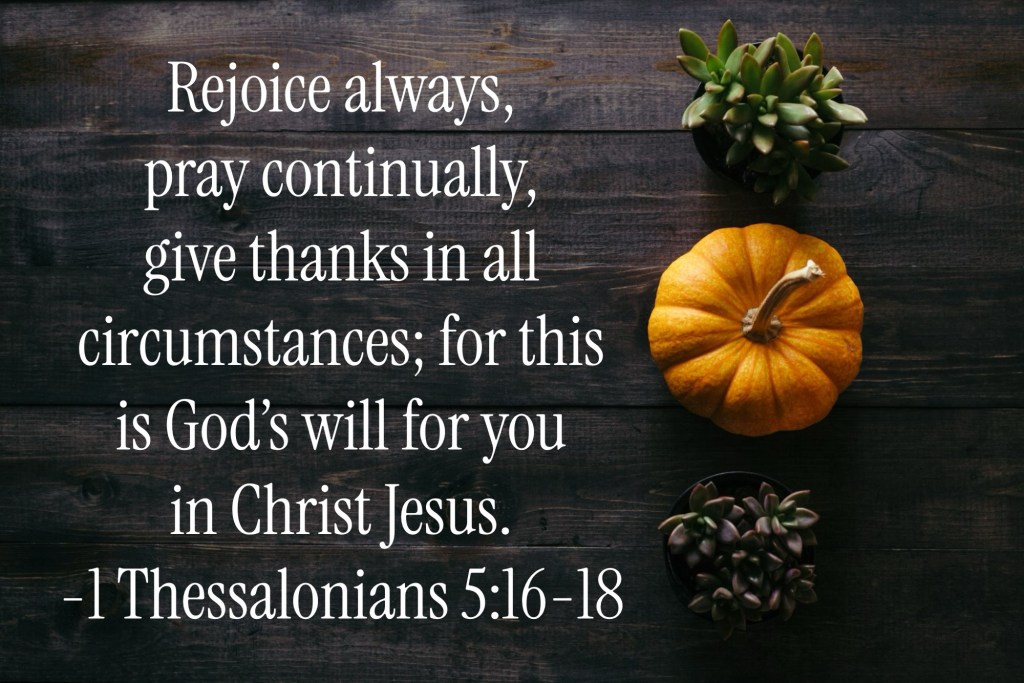
With today being Thanksgiving Day in the USA, I want to take a moment to wish you a Happy Thanksgiving. No matter what part of the world you live in, I hope you will take time today to thank God for all the blessings in your life.
As you may know, I lost my dad earlier this year. I’m sure you can understand the heaviness of facing the holidays after losing a loved one. Of course I miss him and wish he could be here. However, I also know he is in a better place and I will see him again one day. This helps me face Thanksgiving with peace and love.
I also wanted to share a quick memory about my dad. I’m originally from New York, but I attended college in North Carolina. On one particular Thanksgiving during my college years, I had to fly home to make a visit to the orthodontist. Except for my dad, the rest of the family was in Florida where one of my grandmothers lived. My high school friends were planning on going to the Macy’s Thanksgiving Day Parade and invited me along. When I mentioned this to my father he said it was up to me, and I could do whatever I wanted.
I asked, “Really? Whatever I want and you won’t mind?”
“No, I won’t mind,” he replied.
So I said, “Okay, I’d rather go to the parade with you.”
He probably didn’t see that coming and might have regretted his initial statement. 😂 We got up early, took the train into the city, enjoyed the parade, and then headed back home for a turkey dinner. It was a cold day, and we even had some snow flurries. I’m really grateful for that time we shared.
If you are missing loved ones today, try to hold onto the special memories that make you smile.
And no matter what your day looks like, or where you are in the world, remember all the blessings in your life.
“If you woke up this morning with more body parts that don’t hurt than those that do, you are blessed. If you have food, clothes, and a place to live, you are more secure than 75 percent of the world. If you have money in the bank, in your wallet, or spare change at home, you are among the top 8 percent of the world’s wealthiest people. If you have never experienced the danger of battle, the loneliness of imprisonment, the agony of torture, or the pangs of starvation, you are ahead of 500 million people in the world. If you read this message, you are more blessed than two billion people in the world who cannot read.” [1]
We have so much to be thankful for. Let us try to change our perspective. Instead of focusing on the negative, we can choose to focus on the positive. I know it takes practice, but it’s worth it.
Our Heavenly Father does so much for us, every single day. May we learn to stop and look around, and see God’s goodness in our lives. Every day is a gift from God!
One of the things I am grateful for today is all you. Thank you for being here and for walking by my side. I pray you and yours have a Happy Thanksgiving!
© 2018-2025 Bridget A. Thomas. All rights reserved.
[1] The Power of Being Thankful by Joyce Meyer. Copyright © 2014 by Joyce Meyer. Published by FaithWords, a division of Hachette Book Group, Inc.
Psalm 23 – Verse 5

This is a long post. You might want to grab a cup of coffee or tea to enjoy while you read. ☕️
You prepare a table before me in the presence of my enemies; You anoint my head with oil; My cup runs over. – Psalm 23:5 NKJV
You prepare a table before me in the presence of my enemies
There are two points to consider when we read about the table in this verse. Tablelands and feast.
Let’s start with tablelands. When David wrote this Psalm, some scholars think he had tablelands in mind. Tablelands are high plateaus where the sheep are taken during summer months. But the shepherd has to prepare the “table” ahead of time by clearing the land of anything that could bring harm to the sheep – holes, rocks, poisonous plants, to name a few things. This is painstaking work.
And when they are up in the high mountains, they are far from civilization. This means there are more predators around watching the sheep for an easy meal. This brings to light how the sheep are in the presence of enemies. The shepherd has to stay alert at all times, protecting the sheep from attack.
Being a shepherd himself, we know David, the author of Psalm 23, experienced this kind of situation firsthand. In the famous story when David faced Goliath, he was a young man at the time. This was prior to becoming king. The king at the time, Saul, protested because he didn’t think David could handle Goliath. However, David said to Saul:
“Your servant has been keeping his father’s sheep. When a lion or a bear came and carried off a sheep from the flock, I went after it, struck it and rescued the sheep from its mouth. When it turned on me, I seized it by its hair, struck it and killed it. Your servant has killed both the lion and the bear; this uncircumcised Philistine will be like one of them, because he has defied the armies of the living God. The Lord who rescued me from the paw of the lion and the paw of the bear will rescue me from the hand of this Philistine.” (1 Samuel 17: 34-37 NIV)
This gives us a glimpse of the threats that the sheep face. If they didn’t have a shepherd fighting for them, they would be destroyed.
There are also many authors who, when reflecting on this verse, write about a feast. At this point David is no longer speaking in terms of shepherd and sheep; he is now focusing on the roles of host and guest.
“To prepare a table was to make ready a feast. It was to do more than to give a loaf of bread to a weary pilgrim. It was to detain one as a guest and set before him the best of everything that could under the circumstances be had.” [1]
A couple of weeks ago when we focused on verse 3, I mentioned the story of the prodigal son. This story comes to mind again, because in this story we can see how the father had a big feast prepared for his son.
See Luke 15:11-32. Verses 22-24 I particularly want to highlight. “But the father said to his servants, ‘Bring quickly the best robe, and put it on him, and put a ring on his hand, and shoes on his feet. And bring the fattened calf and kill it, and let us eat and celebrate. For this my son was dead, and is alive again; he was lost, and is found.’ And they began to celebrate.”
The father wanted to make sure his younger son had the best of everything. God also celebrates us as His beloved children. He wants only what’s best for us.
And remember in the story of the prodigal son how the older son behaved? He was prideful and jealous of what the father did on his brother’s behalf. But the father told the older son, “Son, you are always with me, and all that is mine is yours” (v. 31). In His great love, God gives us everything. He doesn’t hold back.
In Romans 8:32 (NLT) it says, “Since [God] did not spare even his own Son but gave him up for us all, won’t he also give us everything else?”
God extends His goodness and blessings to us each and every day.
“In a figurative sense, God’s table is His favor, blessing, and communion extended to us. It’s an invitation to partake of the good things of God. It’s an opportunity to accept God’s provision, experience His protection, and enjoy His pleasure.” [2]
Notice how this verse says “You” prepare. This means God is the one preparing the table. In David’s culture if someone was invited over for dinner there would have been servants preparing the food and the table. But God, in His great love, prepares the table for us. This shows us, all the more, how great His love is. What a magnificent Heavenly Father we have.
This also makes me think of the parable that Jesus told about those invited to the marriage banquet. The original list of invitees declined their invitation. So a new set of people were brought to the party. Basically, anyone they could find on the streets. (See Matthew 22:1-14).
This reminds us that many of God’s chosen people, who were originally invited into a relationship with Him, didn’t accept His offer. But God’s offer is for all the world. Any of us who will accept Him. All we have to do is accept our invitation in order to enjoy the feast. How amazing it is that God offers us so much. Let’s take a moment today to thank the Lord for a seat at the table.
In this verse, it doesn’t just say the Lord will prepare a table before us. But it adds an additional layer – the table is prepared in the presence of enemies. David, the author of this Psalm, knew a lot about enemies. Throughout his life he was faced with too many enemies to count.
As children of God, our main enemy is satan. He can’t have our souls, but he does try to steal our peace while we are on this earth. He tries to take us off course, because we are doing Kingdom work. And often times the battles we face in life are coming from him. The stress and worries that sneak into our lives can be the work of the adversary. He will use whatever he can to push our buttons and get us off course.
But one thing to remember is that Jesus already won the battle. We don’t have to worry about the enemy, when we have God Almighty beside us. He will be sure to see us through any trouble we face.
Unfortunately, though, we might give the enemy too much credit or focus in our lives. By that I mean that we might allow the troubles he brings our way to take us down. We might allow worry to take over our minds. We might allow bitterness to get into our hearts. We might allow the enemy’s destruction to appear bigger than God’s feast.
As pastor Louie Giglio aptly says in the title of one of his books – “Don’t give the enemy a seat at your table.”
When we are being attacked by the enemy, our faith needs to speak louder than our troubles. This is not necessarily our instinct. So we have to take action through prayer and holding onto God’s promises. We have to walk and talk like our God is mightier than anything the enemy throws at us. We have to sing praises to the One who is fighting our battles. When we put our focus on God instead of our battles, it helps us to properly place power in the right place.
You anoint my head with oil
As there were several angles to look at regarding the table, this is also the case with oil. As we go through this, keep in mind that anointing with oil in the Bible is often associated with the Holy Spirit and God’s Presence in our lives.
Oil has a number of useful benefits for tending sheep. From the perspective of a shepherd, Phillip Keller wrote about oil deterring the array of insects that pester sheep. “There are warble flies, bot flies, heel flies, nose (nasal) flies, deer flies, black flies, mosquitoes, gnats, and other minute, winged parasites.” The nasal flies are one of the most aggravating. “For relief from this agonizing annoyance, sheep will deliberately beat their heads against trees, rocks, posts, or brush. They will rub them in the soil and thrash around against woody growth.” In order to prevent this, a shepherd would rub oil on the sheep’s nose and head. “What an incredible transformation this would make among the sheep. Once the oil had been applied to the sheep’s head, there was an immediate change in behavior. Gone was the aggravation, gone the frenzy, gone the irritability and the restlessness. Instead, the sheep would start to feed quietly again, then soon lie down in peaceful contentment.” [3]
This is a reminder of how little annoyances in life can cause a lot of destruction, if we allow them to. But God’s presence in our lives is like an anointing that brings peace. When we are with our Good Shepherd, the little gnats don’t have the power to pester us. Note, though, that it’s not a one-time thing. Just as the sheep would need the oil reapplied at times, we too need to continually commune with our Shepherd.
Oil can also be used on sheep to aid in healing wounds. This reminds us that the Lord’s Presence in our lives heals our hurts.
“It’s often during life’s hurts that we come to understand the heart of the Shepherd, as we learn to accept His care and to trust His heart. As He tends us and mends us, we fall in love with Him and receive the comfort He gives.” [4]
Oil can also prevent injury on feisty rams who want to butt heads. When we seek the Presence of God consistently, He helps us to walk in peace where we are less likely to butt heads with those around us.
Our daily action of spending time with the Lord brings immeasurable blessings that we might not even understand.
“The sheep doesn’t understand why the oil repels the flies. The sheep doesn’t understand how the oil heals the wounds. In fact, all the sheep knows is that something happens in the presence of the shepherd. And that’s all we need to know as well. ‘LORD, I give myself to you; my God, I trust you.’” [5]
Something else to consider is that David was anointed with oil when he was chosen to become the second king of Israel. (See 1 Samuel 16:1-13.) In this case, the act of being anointed is symbolic of being chosen. And as God’s children, we too are chosen. What a privilege it is to be chosen by God.
In John 15:16 (NIV), Jesus said, “You did not choose me, but I chose you and appointed you so that you might go and bear fruit—fruit that will last—and so that whatever you ask in my name the Father will give you.”
(Funny story about oil. Last week we received a box from Amazon which was supposed to have a bottle of vitamin D3 softgels in it. But instead it had a bottle of anointing oil from the Holy Land. My husband and I agreed that God had to have sent this!)
My cup runs over
The word cup here is symbolic of blessings. In another Psalm by King David, he wrote “LORD, you alone are my portion and my cup; you make my lot secure” (Ps 16:5 NIV). The Amplified Bible puts it this way: “The LORD is the portion of my inheritance, my cup [He is all I need]; You support my lot.” I love that statement – “He is all I need.”
Jesus, our Good Shepherd, brings us abundance. In John 10:10b ESV, Jesus said, “I came that they may have life and have it abundantly.”
Note that in Psalm 23 it says that “my cup runs over.” God doesn’t just fill our cup, but He gives us so much that the blessings run over.
“The overflowing cup was a powerful symbol in the days of David. Hosts in the ancient East used it to send a message to the guest. As long as the cup was kept full, the guest knew he was welcome. But when the cup sat empty, the host was hinting that the hour was late. On those occasions, however, when the host really enjoyed the company of the person, he filled the cup to overflowing. He didn’t stop when the wine reached the rim; he kept pouring until the liquid ran over the edge of the cup and down the table.” [5]
This is incredible to consider. This helps us to understand how deeply God wants to be with us. God loves our company and He wants us to know it. He wants us to continually commune with Him. This is our God’s heart for us. He loves us so much and wants to bless us.
Thanksgiving Day in the USA will be celebrated on Thursday; and I believe in light of what we learned here today this is a wonderful verse to ponder and express our gratitude to God.
God loves us so much. It’s humbling and overwhelming to think about it. I wish we could always remember this. Yet too often we complain about minor grievances. May we pray for God’s forgiveness when we are quick to complain. May we learn to keep our eyes open to His love and His goodness. And may we love Him in return, with all of our heart, soul, mind, and strength.
Thank you for reading. I will be back on Thursday with a quick post. God bless!
© 2018-2025 Bridget A. Thomas. All rights reserved.
[1] William S. Plumer, Psalms: A Critical and Expository Commentary with Doctrinal and Practical Remarks, (Edinburgh: Banner of Truth, 1975), 314.
[2] Psalm 23 – Bible Study by Jennifer Rothschild. Published by LifeWay Press® • © 2018 Jennifer Rothschild.
[3] A Shepherd Looks at Psalm 23 by W. Phillip Keller. Copyright © 1970, 2007, 2015 by Phillip Keller. Published in Grand Rapids, Michigan, by Zondervan.
[4] The Lord is My Shepherd by Robert J. Morgan. Copyright © 2013 by Rob Morgan. Published by Howard Books.
[5] Safe in the Shepherd’s Arms: Hope and Encouragement from Psalm 23 by Max Lucado. Copyright © 2002, 2009 by Max Lucado. Published by Thomas Nelson.
Psalm 23 – Verse 4
Yea, though I walk through the valley of the shadow of death, I will fear no evil; For You are with me; Your rod and Your staff, they comfort me. – Psalm 23:4 NKJV
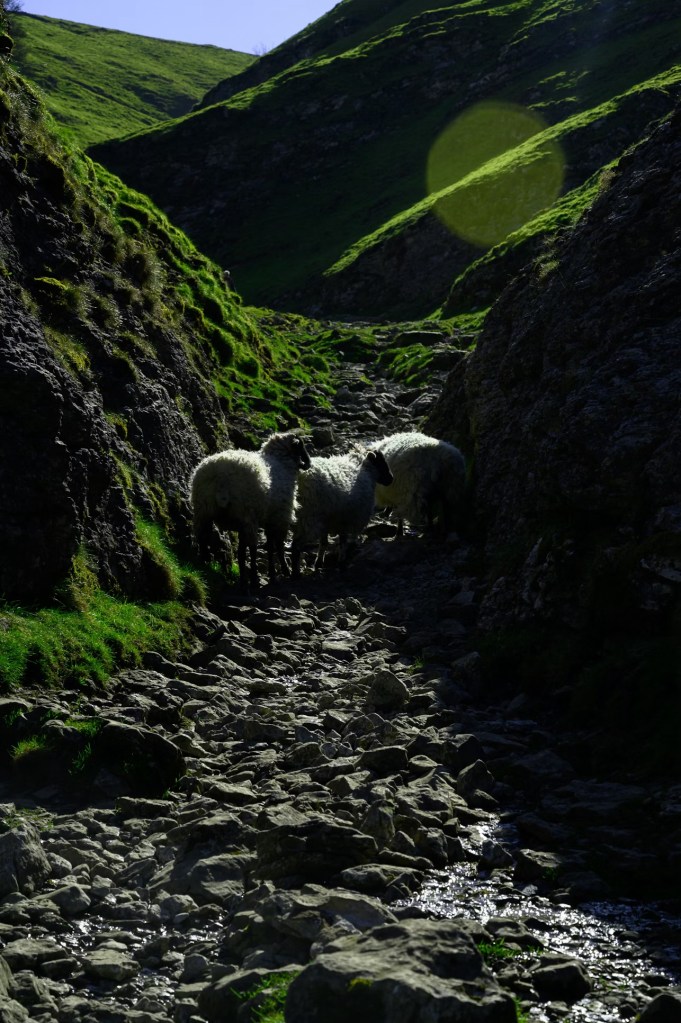
Yea, though I walk through the valley of the shadow of death
This verse is why we often hear this Psalm at funerals. Due to the fact that this Psalm reminded me of funerals, I didn’t appreciate it in my younger days. But after I really began studying this Psalm more, I grew to understand it better. And now it has become my favorite Psalm.
Something to keep in mind is that it says the “shadow” of death. It is not death itself. The original Hebrew word means “deep darkness.” As Christians we don’t have to fear death itself. When we pass on from this life, we will be in heaven with our Lord and Savior.
“The Good Shepherd laid down His life for His sheep and bore our death full force. As a result, we’re hit only by the shadow of death. There is no such thing as real death for the Christian.” [1]
This is good news! This is reason for us to rejoice every day.
However, while on this earth, we will still walk through dark times and valleys. While it’s usually not something we would choose, it is reality.
You might wonder why I said “usually” in that last sentence. This is because there are times when we cause our own dark valleys. There are often three ways the darkness comes into our lives – our own sinful nature, the world, and the enemy.
The good news is that no matter what the case may be, we can turn to our Heavenly Father. We can seek His help and guidance towards a better path. And we can find peace in His arms.
It says in Psalm 139:12 (NKJV), “Indeed, the darkness shall not hide from You, But the night shines as the day; The darkness and the light are both alike to You.”
It doesn’t matter whether it’s night or day, it’s all light to the One who is holding our hand. So even when we are walking in deep darkness, we can cling to our Good Shepherd and He will lead the way.
And these words that David wrote thousands of years ago help show us the way. The words “walk through” in this verse tell me two things. First, when dark times come, we have to keep walking out our faith to help us get to the other side. And second, if we are “walking through” this means we won’t get stuck there. The challenges we face will pass. Some circumstances take longer than others. And no doubt all of our troubles take longer than we would like. But they will pass. As we walk through the valleys of life, let us remember to keep trusting in the Lord every step of the way.
“We must trust God. We must trust not only that he does what is best, but that he knows what is ahead.” [2]
I realize this isn’t always easy. And I don’t say any of this lightly. Thankfully, this twenty-third Psalm has been teaching us that our Shepherd is always there and always caring for us. Which brings us to our next point in this verse.
I will fear no evil; For You are with me
Something beautiful in this verse is the reminder that our Good Shepherd is with us. No matter what we are walking through, He doesn’t leave our side. Sometimes we might wonder about this. We might think He is not there or He is not helping us. But our human eyes are limited. We can’t always see what the Lord is doing. We have to rely on the truth that we know. We have to remind ourselves that He is with us and He is working on our behalf.
“God is 100 percent committed, 100 percent involved, and 100 percent purposeful in everything He allows into our lives.” [3]
When we walk through darkness, this should push us closer to the Lord. We should be clinging to Him like never before. In the midst of trials, we can find refuge in our Almighty God.
Isaiah 40:11 (NIV) says, “He tends his flock like a shepherd: He gathers the lambs in his arms and carries them close to his heart; he gently leads those that have young.”
This is our God’s heart for us. He wants to gather us close, especially when we are walking through a difficult season.
This verse tells us that we don’t have to fear. However, I know our fears can feel very real in our hearts and minds. At times our fears might even be irrational, yet they still can be difficult to shake.
“Sometimes we think of fear as an emotion, but we need to realize that fear is actually a spirit. In fact, I believe fear is one of Satan’s favorite tools, and he particularly loves to torment Christians with it. At every possible opportunity, he will whisper in your ear, telling you that God has forgotten you and there is no hope.” [4]
Remember there is always hope, when we have Jesus. Our Shepherd’s perfect love casts out fear. (See 1 John 4:16-18.) So when fear strikes, let us remind ourselves to hold onto the Lord and His perfect love.
Psalm 56:3 says, “When I am afraid, I will put my trust in you.” This takes a conscious decision on our part – to trust God. But we can choose to do just that, when fears hit us.
“In order to teach you faith, the Father must bring you to the end of yourself so you will choose to trust Him. This is a necessary lesson and an indispensible part of maturing you as a believer.” [5]
Notice how in verse 4 of Psalm 23 David switched from talking about his Shepherd in third person, to now talking to his Shepherd in first person. I think this is perfect because talking to Him helps us to acknowledge and feel our Shepherd right beside us.
When we keep in mind that whatever we walk through, the Lord is with us, this changes how we face each day. We are never alone. He is always helping and working on our behalf. We can lean on Him and His strength. The words “You are with me” are words we can hold onto every day.
In fact, “the message of the whole Bible can be summarized in four simple words: ‘You are with me.’” [6]
Your rod and Your staff, they comfort me.
“The rod mentioned in Psalm 23 is a symbol of the Lord’s strength and protection. The rod was a sturdy wooden stick used as a weapon to fight off wild animals who might have hoped to make an easy meal out of an otherwise defenseless flock of sheep. The shepherd also used the rod to help him keep count of the sheep within the flock (as alluded to in Leviticus 27:32).” [7]
“The staff mentioned in Psalm 23 is a symbol of the Lord’s guidance and lovingkindness. The staff was a long, slender stick, often hooked at the tip, used primarily to direct the flock. Sheep are notorious wanderers, and once away from the shepherd’s watchful eye, they get into all sorts of trouble (Matthew 18:12-14). The shepherd used his staff to keep his sheep out of danger and close to himself. If a sheep became trapped in a precarious position, the shepherd would loop the curved end of the staff around the neck of the sheep and retrieve it back to safety.” [7]
When we have a better understanding of the rod and the staff, it’s easy to see why David said they comforted him. David was a shepherd and he had to use his own rod and staff to protect his herd. So David knew well that our Good Shepherd keeps a watchful eye on each of us, in order to protect us and guide us.
No matter what we are walking through, God sees it all. He doesn’t miss a thing. He doesn’t forget a single prayer. He doesn’t stop caring for one second.
We don’t have to doubt that. He is always there. And He is ready to help us in the best way possible. Whether we are in danger or if we are on the wrong path, God is there to help us get to safety.
Our Shepherd is not a weakling. He is strong and mighty. He can handle anything and everything that comes against us. Let us praise God for His never ending love!
Thank you for reading. I hope you have a blessed week.
© 2018-2025 Bridget A. Thomas. All rights reserved.
[1] The Lord is My Shepherd by Robert J. Morgan. Copyright © 2013 by Rob Morgan. Published by Howard Books.
[2] Safe in the Shepherd’s Arms: Hope and Encouragement from Psalm 23 by Max Lucado. Copyright © 2002, 2009 by Max Lucado. Published by Thomas Nelson.
[3] Fully Alive by Susie Larson. Copyright © 2018 by Susie Larson. Published by Bethany House Publishers.
[4] Battlefield of the Mind Bible. Copyright © 2017 by Joyce Meyer. Published by FaithWords, a division of Hachette Book Group.
[5] Every Day in His Presence by Charles F. Stanley. © 2014 by Charles F. Stanley. Published by Thomas Nelson.
[6] The Lord of Psalm 23: Jesus Our Shepherd, Companion, and Host. © 2023 by David Gibson. Published by Crossway.
Psalm 23 – Verse 3

He restores my soul; He leads me in paths of righteousness for his name’s sake. – Psalm 23:3 NKJV
We are continuing our study of the twenty-third Psalm, and today we are looking at verse 3.
He restores my soul
First and foremost, these four words remind us of the priceless gift we have in Jesus. We were born sinners and far from God. Yet long before we were born, Jesus paid our debt. Once we accepted Him, we were saved from death and adopted into God’s own family. Instead of being far from Him, we have been brought near to God. (See Ephesians 2:13.)
What a gift we have in Jesus! Thanks to God’s grace and mercy, we are given so many blessings – here on earth and later in eternity. When we sincerely accept Jesus, we instantly become a child of God and an heir to the Kingdom.
Although we have accepted Jesus into our hearts, it doesn’t mean we live a perfect life. We will still make mistakes and need God’s forgiveness. But God continues to restore us, when we seek Him.
King David, the author of Psalm 23, knew this firsthand. Many scholars believe David wrote this Psalm towards the end of his life. Therefore, when he wrote this, perhaps he was remembering the mistakes in his own life when the Lord restored him.
After David was confronted by the prophet, Nathan, for his affair with Bathsheba and the role he played in the death of her husband, David turned to God for forgiveness. He wrote another beautiful Psalm – Psalm 51. He cried out to God and asked Him to create in him a clean heart.
“When a person is broken in sin, he is not alone. God is with him, and He is quick to restore the person’s fellowship with Him when he acknowledges his sin.” [1]
In Ezekiel 36:26 (NIV), God promised His people, “I will give you a new heart and put a new spirit in you; I will remove from you your heart of stone and give you a heart of flesh.”
We see the depth of the Lord’s love when we see that He wants to restore us. He wants to restore our hearts and our spirits. He wants to transform us to become more like His Son.
As children of God, may we be quick to turn to Him when we mess up. God sees our hearts and knows we are sincere. He forgives us and restores us back to our rightful place.
This brings to mind the story of the prodigal son. When he returned home, his father was already on the lookout for him. The father saw his son from a distance and went running out to him. In this culture, “It was considered undignified for an older man to run.” [2] But he didn’t care. His love for his son took precedence. It didn’t matter where the son had been or what he had done. The father was eager to restore him back to his true status of sonship. (See Luke 15:11-32.)
This is our Heavenly Father’s heart for us! There is no sin too great for Him to forgive us and restore our souls when we turn to Him. He loves us beyond comprehension. He enjoys when we spend time with Him. We are the apple of His eye.
The Lord also restores our weary souls when the burdens of life weigh us down. Jesus said, “Come to me, all you who are weary and burdened, and I will give you rest. Take my yoke upon you and learn from me, for I am gentle and humble in heart, and you will find rest for your souls. For my yoke is easy and my burden is light.” (Matthew 11:28-30 NIV)
Jesus walked this earth and He understands the challenges that bring us down. But He is always there beside us, so we can cast our cares on Him (1 Peter 5:7). And spending time in His presence will bring us restoration. When you are feeling depleted, reach for Him. He wants to comfort you and bring you peace.
“If He is the Good Shepherd, we can rest assured that He knows what He is doing. This in and of itself should be sufficient to continually refresh and restore my soul. I know of nothing which so quiets and enlivens my own spiritual life as the knowledge that God knows what He is doing with me!” [3]
It can be all too easy to lose sight of God’s love for us when we are pulled down by life’s challenges. We have to remind ourselves that “God wants us to flourish. He wants to bless us. He wants to restore our souls, redeem our lives, and see our God-given purposes fulfilled.” [4]
He leads me in paths of righteousness
“Sheep are notorious creatures of habit. If left to themselves, they will follow the same trails until they become ruts, graze the same hills until they turn to desert wastes, pollute their own ground until it is corrupt with disease and parasites.” [3]
Sometimes human beings can be that way too. We are creatures of habit as well. And those habits can create ruts in our lives.
The sheep need their shepherd to lead them to better paths. And we too need our Good Shepherd to lead us.
In Isaiah 43:19 (ESV) it says, “Behold, I am doing a new thing; now it springs forth, do you not perceive it? I will make a way in the wilderness and rivers in the desert.”
God wants to do something new in our lives. But we have to allow Him to lead. And in order to allow the Good Shepherd to lead, in order to follow Him, it’s important for the sheep to know His voice. We don’t want to follow just anybody or listen for just any voice. Our Shepherd’s voice should be the most prominent voice in our lives.
In John 10, Jesus tells us that He is the Good Shepherd. And in this same chapter, He also stresses the importance of knowing His voice.
- “The sheep listen to his voice. He calls his own sheep by name and leads them” (v. 3).
- “His sheep follow him because they know his voice” (v. 4).
- “My sheep listen to my voice; I know them, and they follow me” (v. 27).
How do we become familiar with His voice? By reading the Bible, spending time in His Presence, praying daily, and clearing the noise of this world. When we make an effort to know Him and His voice, the reward is well worth it.
“Our affection for Jesus and our affection for his voice in the Bible are inseparable. We cannot love one without coming to love the other.” [5]
For his name’s sake
I really love the last four words of this verse. Understanding how important and serious God’s name is, these words leave an impact.
“God’s name represents His character. God always acts according to His character and, ultimately, for His name’s sake… The path a shepherd chooses reflects the shepherd’s character—his management of his sheep, his integrity, his compassion, and his ability. The condition of the sheep is a reflection of the shepherd. God’s honor is at stake in the way He is leading your life. That’s why what He is doing for you and in you is ultimately for His name’s sake.” [6]
This is good news because it means we can trust our Shepherd every step of the way. Sometimes the paths He leads us down might not make sense. With our human eye, we can’t figure out why we have to walk this path. But because He leads us for His Name’s sake, we can trust that He will never lead us astray. It would go against His character and His name to do so. What comfort that brings!
We have such a magnificent Shepherd. When we allow Him to lead, we will have no regrets.
Thank you for stopping by and reading. I hope your week is blessed!
© 2018-2025 Bridget A. Thomas. All rights reserved.
[1] Your Path to Purpose, Passion, and Peace: 90 Days of Timeless Wisdom by Charles F. Stanley. © 2025 by Charles F. Stanley. Published by Zondervan.
[2] NIV Cultural Backgrounds Study Bible, Copyright © 2016 by Zondervan.
[3] A Shepherd Looks at Psalm 23 by W. Phillip Keller. Copyright © 1970, 2007, 2015 by Phillip Keller. Published in Grand Rapids, Michigan, by Zondervan.
[4] Prevail by Susie Larson. Copyright © 2020 by Susie Larson. Published by Bethany House Publishers.
[5] The Lord of Psalm 23: Jesus Our Shepherd, Companion, and Host. © 2023 by David Gibson. Published by Crossway.
[6] Psalm 23 – Bible Study by Jennifer Rothschild. Published by LifeWay Press® • © 2018 Jennifer Rothschild.
VETERANS DAY 2025
November 11th is Veterans Day in the USA. I cannot think about Veterans Day (or veterans in general) without thinking about my dad, who served in the United States Army.
Each year I would get my dad a card, thanking him for his service. In 2023, my husband and I went from store to store, but we were unable to find any Veterans Day cards. I had to improvise and get a generic “thank you” card instead.
In 2024 I made it a point to order a Veterans Day card on Amazon ahead of time. I’m glad I did, because it was my father’s last Veterans Day here on earth.
I’m telling you all of this to say – go out of your way to show your loved ones that you care. They will appreciate it, more than you know. And you will be thankful you did it. A double blessing for both you and them.
And I want to extend my heartfelt gratitude to anyone who has served or is currently serving. Thank you for your service!



© 2018-2025 Bridget A. Thomas. All rights reserved.
Psalm 23 – Verse 2

He makes me to lie down in green pastures. He leads me beside the still waters. – Psalm 23:2 NKJV
We are continuing our study of Psalm 23, and today we are looking at verse 2.
He
Notice in these words the role “He” takes. The Lord and the Shepherd is the one who is in control. The sheep doesn’t lie down on his own. The sheep doesn’t find his own way to the still waters. The Shepherd led him there. When the sheep needed rest or water, he didn’t have to worry about getting access to them. The Shepherd took care of those needs for him.
Our God will supply all of our needs when we allow Him to be our Lord. We don’t have to worry about a thing when we are following our Shepherd.
As apostle Paul wrote, “And my God will liberally supply (fill until full) your every need according to His riches in glory in Christ Jesus” (Philippians 4:19 AMP).
The Amplified version broadens our understanding with these words: liberally, fill until full, and every need. These words help us see the Shepherd’s love. He gives us plenty of what we need. He always has more than enough to give us. We can rest easy when we are in God’s hands.
He makes me to lie down in green pastures.
Lying down in green pastures might sound like something a sheep would willingly do. However, according to W. Phillip Keller in his enlightening book A Shepherd Looks at Psalm 23, “The strange thing about sheep is that because of their very makeup it is almost impossible for them to be made to lie down unless four requirements are met … It is significant that to be at rest there must be a definite sense of freedom from fear, tension, aggravations, and hunger.” [1]
This sounds a lot like humans, doesn’t it? We often tend to have worries and fears on our minds. Life brings stress and tension our way. We have a myriad of things that cause aggravation. And we sometimes allow hunger (for food or for other things) to keep us unsettled. All of this keeps us from finding true rest and contentment.
But Keller goes on to reflect, “In the course of time I came to realize that nothing so quieted and reassured the sheep as to see me in the field. The presence of their master and owner and protector put them at ease as nothing else could do, and this applied day and night.” [1]
Now that’s a beautiful picture and one we can learn from. When we keep our focus on the Good Shepherd, we find peace. As it says in Isaiah 26:3 (NKJV): “You will keep him in perfect peace, whose mind is stayed on You, because he trusts in You.”
Even in the midst of our worries, we trust that He is in control and He is on our side. Psalm 56:9b (NLT) reminds us, “This I know: God is on my side!”
When we allow our Shepherd to lead us, we can find rest from life’s ups and downs. But it’s important to remember – “There is a direct link between our surrender to God and the rest we receive from God.” [2]
Wow. That truth really hits home for me. Does it for you too? We tend to get in our own way. There are many reasons why this could be so.
It could be that relinquishing control to God makes us uncomfortable because we are used to handling everything ourselves. Or perhaps the challenges in front of us are so great that worry overcrowds our minds. Even just the fact that God is out of sight, but our problems are right there in front of us, can cause us to struggle with surrendering to Him. And it might feel like God isn’t working fast enough, so we take matters into our own hands.
I think it would do us all some good to prayerfully seek ways we might be getting in our own way. Why aren’t we allowing ourselves to fully surrender to God? What would it take for us to completely rest in Him?
When we learn to truly trust God and allow Him to lead, we will find the peace that surpasses understanding (Phil 4:7). Even in the midst of life’s difficulties, we can lie down in green pastures knowing that our Heavenly Father is watching over us and handling our concerns.
He leads me beside the still waters.
The Shepherd is the one that leads His sheep to the water. It is His responsibility to make sure His sheep aren’t dehydrated. W. Phillip Keller wrote, “It will be noticed that here again the key or the clue to where water can be obtained lies with the shepherd. It is he who knows where the best drinking places are. In fact, very often he is the one who, with much effort and industry, has provided the watering places. And it is to these spots that he leads the flock.” [1]
When we stay close to the Shepherd, He will make sure we are never thirsty. Jesus is our source of living water. In John 4:14 (NIV) Jesus said, “Whoever drinks the water I give them will never thirst. Indeed, the water I give them will become in them a spring of water welling up to eternal life.”
Jesus fills us up and keeps us content. But how often do we run towards other things to fill us? This has always been an issue – from the Garden of Eden and every day since. We tend to reach for things that we think will satisfy us. Yet we are left feeling all the more depleted.
Something I find interesting is that sheep get much of their water supply from the dew that’s on the grass they are eating. Early morning hours when the grass is drenched is a key time for the sheep to get their nourishment.
W. Phillip Keller wrote, “In the Christian life it is of more than passing significance to observe that those who are often the most serene, most confident, and most able to cope with life’s complexities are those who rise early each day to feed on God’s Word. It is in the quiet, early hours of the morning that they are led beside the quiet, still waters where they imbibe the very life of Christ for the day.” [1]
This reminds me the importance of seeking the Lord when we start our day. In different seasons of my life, I haven’t always been consistent in this area. But when I am consistent, I can see a difference in my daily life. Seeking Him first thing helps set the tone for our day, brings us peace, and reminds us to follow His lead.
“It’s amazing how He will minister to your troubled heart—giving you unfathomable life, joy, peace, and direction—when you take the time just to sit in His presence.” [3]
I want to point out that the Shepherd doesn’t lead His sheep to just any kind of water, but to still waters. This, too, reminds me of how important it is to be still with the Lord. Savoring our time with the Lord is life-giving. When we turn down the noise of the world, we are more capable of hearing His gentle whisper (see 1 Kings 19). I dare say we’ve all had moments of clarity when we allowed our minds to rest. Perhaps we prayed about something. Then later when we went out for a walk, we received our answer. God wants to speak to us, but are we listening?
I just want to make a note that I am not saying any of this with judgment because I am preaching to myself too. Some of these things we might know in our minds, but it can be difficult to follow through with our actions. I pray we can remove any obstacles that are preventing us from seeking the Lord, and we can learn to truly rest in Him.
Bonus Reading – My friend Alicia recently reflected on similar topics, from her first-hand perspective as a goat keeper, in her inspiring post The Well Beaten Path.
Thank you for reading. I will be back next week to discuss verse 3. God bless!
© 2018-2025 Bridget A. Thomas. All rights reserved.
[1] A Shepherd Looks at Psalm 23 by W. Phillip Keller. Copyright © 1970, 2007, 2015 by Phillip Keller. Published in Grand Rapids, Michigan, by Zondervan.
[2] Psalm 23 – Bible Study by Jennifer Rothschild. Published by LifeWay Press® • © 2018 Jennifer Rothschild.
[3] Every Day in His Presence by Charles F. Stanley. © 2014 by Charles F. Stanley. Published by Thomas Nelson.
Psalm 23 – Verse 1

The Lord is my shepherd; I shall not want. – Psalm 23:1 NKJV
Do you want to live a Psalm 23 life? Do you want to live a life of true contentment? Do you want to live in peace knowing that, no matter what, the Lord is there for your every need?
To begin this journey of living a Psalm 23 life, today we are looking at the first verse of this well-known Psalm. “The Lord is my shepherd; I shall not want.” I’m sure you’re familiar with these famous words. Even so, let’s take a closer look at the different aspects of this verse.
The Lord
Who is the Lord? It’s important to know who the Lord is if we want to truly live this Psalm. God is so magnificent and vast that we could spend a lifetime studying who He is.
In the story where Moses encountered the burning bush in Exodus, it helps bring some perspective. God planned to rescue the Israelites from Egypt and He wanted Moses to help. Moses wasn’t too eager about this plan because he could only see his own shortcomings. He was focused on himself, rather than God. It makes me cringe when I read how he argued with God on this. But each time Moses spoke, God came back with a solid answer.
I particularly want to point out verses 13-15 (NKJV):
13 Then Moses said to God, “Indeed, when I come to the children of Israel and say to them, ‘The God of your fathers has sent me to you,’ and they say to me, ‘What is His name?’ what shall I say to them?”
14 And God said to Moses, “I AM WHO I AM.” And He said, “Thus you shall say to the children of Israel, ‘I AM has sent me to you.’ ”
15 Moreover God said to Moses, “Thus you shall say to the children of Israel: ‘The Lord God of your fathers, the God of Abraham, the God of Isaac, and the God of Jacob, has sent me to you. This is My name forever, and this is My memorial to all generations.’ ”
(A brief lesson that might be helpful: the words “I AM” and “I AM WHO I AM” are linked to the Hebrew letters YHWH. In the past, theologians translated this to the name Jehovah. However, it was later determined that Yahweh was the best pronunciation. This is why sometimes God is referred to as Jehovah and sometimes He is referred to as Yahweh.)
When we read the verses above, they might be a bit confusing and leave us wondering exactly what God meant by “I AM WHO I AM.” However, in this statement God is helping us to understand how completely unchanging and trustworthy He is.
“This explains his name Jehovah, and signifies, 1. That he is self-existent: he has his being of himself. 2. That he is eternal and unchangeable, and always the same, yesterday, to-day, and for ever. 3. That he is incomprehensible; we cannot by searching find him out: this name checks all bold and curious inquiries concerning God. 4. That he is faithful and true to all his promises, unchangeable in his word as well as in his nature; let Israel know this, I AM hath sent me unto you. I am, and there is none else besides me. All else have their being from God, and are wholly dependent upon him.” [1]
Thinking about God from this angle, we get a bigger picture of who He is. He is above everything we know. He is eternal and unchangeable. He is faithful. He is the most dependable being there ever was or ever will be. And to think we can call Him our Shepherd is a weighty thought.
The Shepherd
If we truly want to live Psalm 23 it also helps to understand the life of a shepherd. The best kind of shepherd in particular. If the shepherd is a good shepherd, then his life will revolve around his sheep. Every season and every day. The sheep’s best interest is on the shepherd’s mind. The shepherd wants his sheep to be healthy, to be protected, and to be provided for. Whatever the sheep needs in any given moment is where the shepherd’s mind and energy are. And the shepherd has to plan ahead too, anticipating what may come. The shepherd is always alert, watching for anything that might bring harm to the sheep.
This is our Savior! This is our Good Shepherd. To think how His mind is always on us and our every need – this is stunning. 😭 Just think about that for a moment. What a gift we have in Jesus! 🙌
The Lord is my Shepherd
Now we have a better outlook on just how incredible it is to say “The Lord is my Shepherd.”
But I really appreciate something Robert J. Morgan pointed out, “You can’t say, ‘The Lord is my Shepherd’ unless you also say, ‘The Shepherd is my Lord.’” [2]
Is Jesus your Lord and Savior? Are you willing to follow Him and surrender to His will? Do you trust Him, because you know He will always have your back? Are you willing to make Him your life, knowing that He gave His life for you?
(If you have not accepted Jesus, but you are ready to do so, please go here.)
Now we have to ask ourselves – who is our Shepherd? Is the Lord our Shepherd? Are we our own shepherd? Is someone else our shepherd? Is something we continually seek our shepherd?
“All of us are shepherded—whether we realize it or not—because we’re all led by something.” [3]
We all need a shepherd. And I pray we will allow the Lord to be our Shepherd. He is the very best Shepherd. And He will never let us down. What a gift it is that we can claim the Good Shepherd as our Shepherd.
I shall not want
When the Bible was originally translated into English, scholars agree that this one line was inadequate. The original Hebrew would have been better translated as “I lack nothing.” In this life there is nothing we will ever lack or need, when we choose to follow Jesus.
In the words of Jesus, “Seek the Kingdom of God above all else, and live righteously, and he will give you everything you need.” (Matthew 6:33 NLT).
This is where we find true contentment – when we allow the Lord to be our Shepherd and we realize we are in need of nothing. He will supply all of our needs (see Philippians 4:19).
“There is absolutely nothing that God lacks. We must understand this, because the overflowing sufficiency that we will experience when Yahweh is our Shepherd lies in the all-sufficiency of the Shepherd himself. If we do not understand the all-sufficiency of the Shepherd, we will never experience that sufficiency in relationship to him. What we need, God has—in infinite supply.” [4]
When the apostle Paul was imprisoned, he wrote about true contentment. He told the recipients of his letter that through Christ Jesus he was never in need. He learned to be content with whatever he had. (See Philippians 4:10-13.) Can we too live this kind of life? Yes, we can!
It takes effort on our part. The enemy will try to feed us lies. But we have to remind ourselves of truth. The Lord loves us beyond measure and He is always looking out for us. He is always there, protecting us and providing for us. We walk by faith, not by sight (2 Corin 5:7). We keep our focus on our Shepherd and His love, allowing Him to guide our steps.
Every day we have a choice. Will we live in our own strength? Or will we rely on our Good Shepherd? If we choose the latter, we will find that when the Lord is our Shepherd, we lack nothing.
In the coming weeks, as we study each verse of this Psalm, we will get a better understanding of how our Shepherd truly does meet all of our needs.
Bonus Reading – Check out Don White’s heartwarming reflection titled My Shepherd.
Thank you for reading. I will be back next week to look at verse 2. I hope you have a wonderful week. God bless you!
© 2018-2025 Bridget A. Thomas. All rights reserved.
[1] Matthew Henry’s Concise Commentary on the Whole Bible. Copyright © 1997 by Thomas Nelson, Inc.
[2] The Lord is My Shepherd by Robert J. Morgan. Copyright © 2013 by Rob Morgan. Published by Howard Books.
[3] Grace and Glory by Louie Giglio. Copyright © 2024 Louie Giglio. Published by Thomas Nelson.
[4] Life Without Lack: Living in the Fullness of Psalm 23 by Dallas Willard. Copyright © 2018 Willard Family Trust. Published by Thomas Nelson.
Psalm 23 – Introduction

Hi, Friends! Over the next several weeks I am going to share some thoughts on the six verses of Psalm 23.
The Lord put it on my heart to write a series of posts based on this Psalm. I wonder what He was thinking. 😅 There are two reasons why this is daunting. First, many of us know some or all of the verses by heart, even without trying to memorize them. We have heard them so much, they stuck with us. And because these sentences are so familiar to us all, it makes it difficult to approach this subject with fresh insight. On the other hand, there is so much that could be said about these six verses. 118 words in the King James Version; yet countless books and commentaries have reflected on this chapter of the Bible.
Nonetheless, here we are. I am looking forward to all the Lord reveals to us over the coming weeks.
In the U.S. around the time of the American Civil War (1861-1865) this Psalm became a common staple recited at funerals. For those of you who don’t live in the U.S. let me know in the comments if this Psalm is often shared at funerals in your country as well. I’m curious!
Even though this Psalm is often read at funerals, it’s not about death. Once you begin to study it, you will find it is about life with the Good Shepherd, and how He is everything we need. For whatever we might face on this earth, He is enough.
“Years ago, Saturday newspapers routinely carried the sermon topics for the next day in the leading pulpits in town. In Norfolk, Virginia, Reverend R. I. Williams of Fairmont Park Methodist Church picked up the phone and called the local paper to give them his sermon topic. ‘The Lord is my Shepherd,’ he said. The person on the other end said, ‘Is that all?’ Reverend Williams replied, ‘That’s enough.’ The next day the church page carried his sermon topic as ‘The Lord Is My Shepherd—That’s Enough!’ When the Lord is our Shepherd, that is enough. He is enough.” 1
When we remember that the Lord is our Shepherd, this takes a lot of weight off of our shoulders. If a sheep has a Good Shepherd, he doesn’t have to worry about anything. He feels safe because he keeps his focus on his Good Shepherd who will provide all of his needs.
Psalm 23 is a very personal Psalm. Not just for the author, King David. But it is personal to each of us that are God’s children. Take a moment to read through the lines below and put your name in the blank spaces. 2
The Lord is _______ shepherd; _______ shall not want.
He makes _______ to lie down in green pastures;
He leads _______ beside the still waters.
He restores _______ soul;
He leads _______ in the paths of righteousness for His name’s sake.
Yea, though _______ walks through the valley of the shadow of death,
_______ will fear no evil;
For _______ Shepherd is with _______;
His rod and His staff, they comfort _______.
The shepherd prepares a table before _______ in the presence of _______ enemies;
He anoints _______ head with oil; _______ cup runs over.
Surely goodness and mercy shall follow _______ all the days of _______ life;
And _______ will dwell in the house of the Lord forever.
There are so many blessings found in these powerful words. And when we read this Psalm, remembering that the Lord is our personal Shepherd, it changes our outlook on life and the challenges we face.
Before I go, I wanted to say thank you for continuing to be here, even while my writing has been sporadic. And if we have been friends for a bit, then you know that there have been times when I have changed what day of the week I schedule my posts. I have recently decided to try Tuesdays and see how this works out with my schedule. I extend my sincere thanks for reading. I know everyone is busy and it means a lot that you took a moment to stop by.
I will be back next week to look at verse 1. Have a good week and God bless you!
(My plan is to share a song with each post. I have the video embedded below. But if that doesn’t work, the link is also in the caption.)
1 The Lord is My Shepherd: Resting in the Peace and Power of Psalm 23 by Richard J. Morgan (New York, NY: Howard Books, 2013)
2 In her Psalm 23 – Bible Study, I like how Jennifer Rothschild encourages the reader to insert their name into the various lines.
© 2018-2025 Bridget A. Thomas. All rights reserved.
 Bridget A. Thomas